
Four brand names, two medicines
Wegovy and Ozempic both contain semaglutide. Zepbound and Mounjaro both contain tirzepatide. Their FDA labels differ in what each is approved for: Wegovy and Zepbound are labeled for reducing excess body weight and keeping it off long term, while Ozempic and Mounjaro are labeled for blood sugar control in people with type 2 diabetes, among other uses. The injectable forms of all four are taken once a week.
Which one you take, and at what dose, gets decided with whoever prescribes it. A log helps with the conversation that comes after that decision, when you’re both trying to read how treatment is going.
Why doses belong next to the weight trend
Memory compresses months into a few impressions. A dated record keeps the order of events intact, and pairing it with a weight trend makes patterns visible that neither shows alone:
- Response to each step. You can see whether the trend’s slope changed in the weeks after a dose increase.
- Side effects in context. Notes clustered after a step tell a different story from notes scattered at random.
- Gaps and delays. A missed or postponed dose sits right next to whatever the trend did that month.
- The long arc. The NIDDK says most weight loss on weight-management medications takes place in the first six months, so a trend that flattens later in treatment can be read against that pattern.
At an appointment, a question like “when did the nausea start?” can be answered with a date from the log.
Recording titration steps
Both drug families start at a low dose and step up gradually. The Wegovy label calls for titrating every four weeks toward a maintenance dose, and says to follow that escalation to reduce the risk of gastrointestinal side effects. The Zepbound label describes increases in fixed increments after at least four weeks on the current dose. Both labels also tie the schedule to how well each dose is tolerated, so real schedules often drift from the table.
Log each step as its own change, with the date it took effect. That turns the record into a series of four-week-or-longer blocks, and the trend inside each block can be compared with the one before it. If a step was delayed, note that too, since a longer stay at one dose changes what the trend should be compared against.
Writing useful side-effect notes
The Wegovy and Zepbound labels both list nausea, diarrhea, vomiting, and constipation among the most common side effects. The NIDDK adds that most side effects of weight-management medications are mild and often improve with continued use.
A useful note is short and dated. Describe the symptom and its strength, and mention whether it changed how much you ate, since a few days of eating very little can pull the weight trend down and look like the medication working faster. Those notes are also the record your prescriber needs if something feels wrong. Anything severe or persistent is a reason to contact them directly, ahead of the next scheduled visit.
What a dose log can’t show
A shared timeline shows timing. It can tell you the trend flattened two weeks after a step, and it can’t tell you the step caused it. Sleep, illness, a holiday, or a change in diet may line up with the same weeks.
Treat the log as material for a conversation. Questions about changing a dose, or about a side effect, go to the person who prescribed the medication.
Keeping the dose log in Balance Point
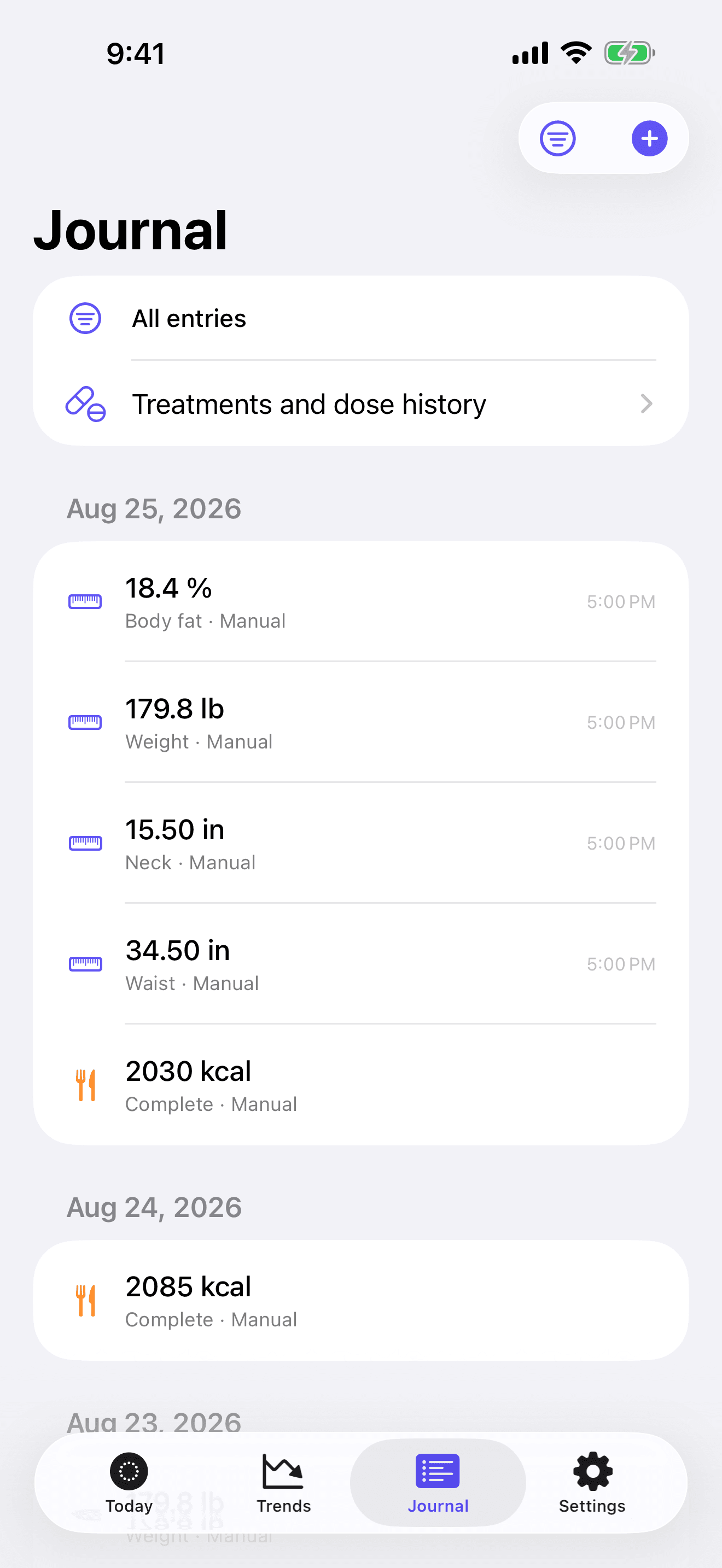
Balance Point stores a medication as a treatment, with each dose logged under it. A repeat of the previous dose is one tap, and titration steps and side-effect notes sit with the doses they describe. On the chart, each dose gets a tick mark and the treatment period is shaded behind the trend. The Journal shows doses in date order, mixed in with weigh-ins, intake, and notes.
Balance Point keeps a record of what you log. It gives no dosing suggestions or medical advice. The treatments feature has more on the log, and if the trend levels off months into treatment, reading a plateau covers stalls in detail.