
Choosing a finish date or a pace
You already know your goal. What’s still open is the timing, and Balance Point lets you settle it from whichever side you already have an opinion about. Name the day you want to arrive and the app derives the pace; name the pace and it derives the day. Either way there’s no date to reconcile with a rate by hand.
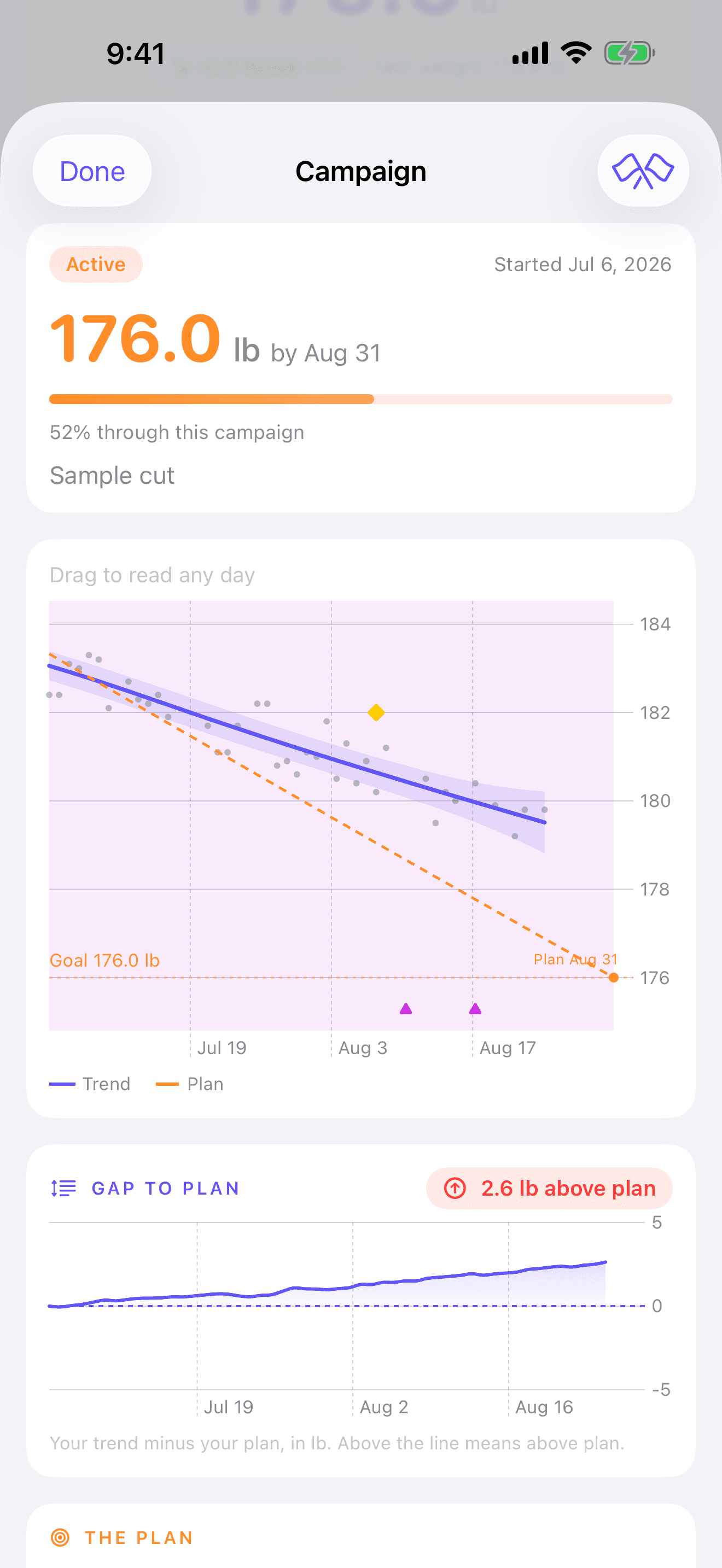
A goal period is a campaign. It can aim for loss, gain, or maintenance, and the plan between your start and your goal can be exponential, linear, a percent of bodyweight, or open-ended.
Pace presets and their week-one numbers
Pace is the change the plan asks for in its first week, measured against bodyweight. A percentage scales with the person: 5 lb in a week means something different at 400 lb than at 175 lb. The three presets, worked out from a 240 lb start:
| Pace | First week, share of bodyweight | First week at 240 lb |
|---|---|---|
| Gentle | 0.75% | 1.8 lb |
| Steady | 1.25% | 3.0 lb |
| Ambitious | 1.75% | 4.2 lb |
Each option lists both numbers beside its name, the first week’s change and the resulting finish date, so you can compare them before picking one.
Guardrails on steep plans
Once a plan asks for more than 1.5% of bodyweight a week, Balance Point notes that it front-loads the change. Past 2%, the app refuses that date and proposes the nearest achievable one. A start at 240 lb aimed at 175 lb in 197 days, for example, would call for about 11.2 lb in the first week, roughly 4.7%, so that date gets declined. Every guardrail message talks about the plan’s numbers.
Where the plan begins
The plan anchors on your trend at the campaign’s first real measurement. That matters when the campaign’s start date sits a few weeks back, or when you return after months without weighing in: the opening point is a weight your weigh-ins support, and the curve runs forward from there.
Restarting and comparing campaigns
A record kept over years usually holds several campaigns, some finished and some set aside partway. Balance Point keeps all of them in one lifetime record, so starting again adds a campaign and leaves the earlier ones intact. Past campaigns can be browsed and compared, so this year’s plan can sit next to the one you ran two years ago.
The data-driven counterpart to the plan is the forecast. For stretches where the trend stops moving, read the guide on plateaus.